


Thanks to our product leadership for this week’s overview of the Box product roadmap, also thanks to our guests who joined and shared in the discussion. You can find the recordings and summary below.
Agenda:
Overview of Box Product Vision by Box Chief Product Officer, Diego Dugatkin
Breakouts:
- Agentic Workflows (Box Automate, Apps, Metadata Extract, etc) - KK Kelash Kumar
- Box AI (Box AI Home, Box Agent, etc) - Matthew Terrell
- Core Platform ( Box Zones, Search 3.0, etc) - Josh Kaplan
- Developer Platform (MCP Server, APIs, CLI, etc) - Bis Palit
- Security and Governance (Box Shield, Watermarking, Collaboration controls, Governance, etc) - Manoj Asnani
Overview by Box Chief Product Officer, Diego Dugatkin
Main Topics: A Vision for Intelligent Content
Diego Dugatkin, Chief Product Officer at Box, explained the overall vision.
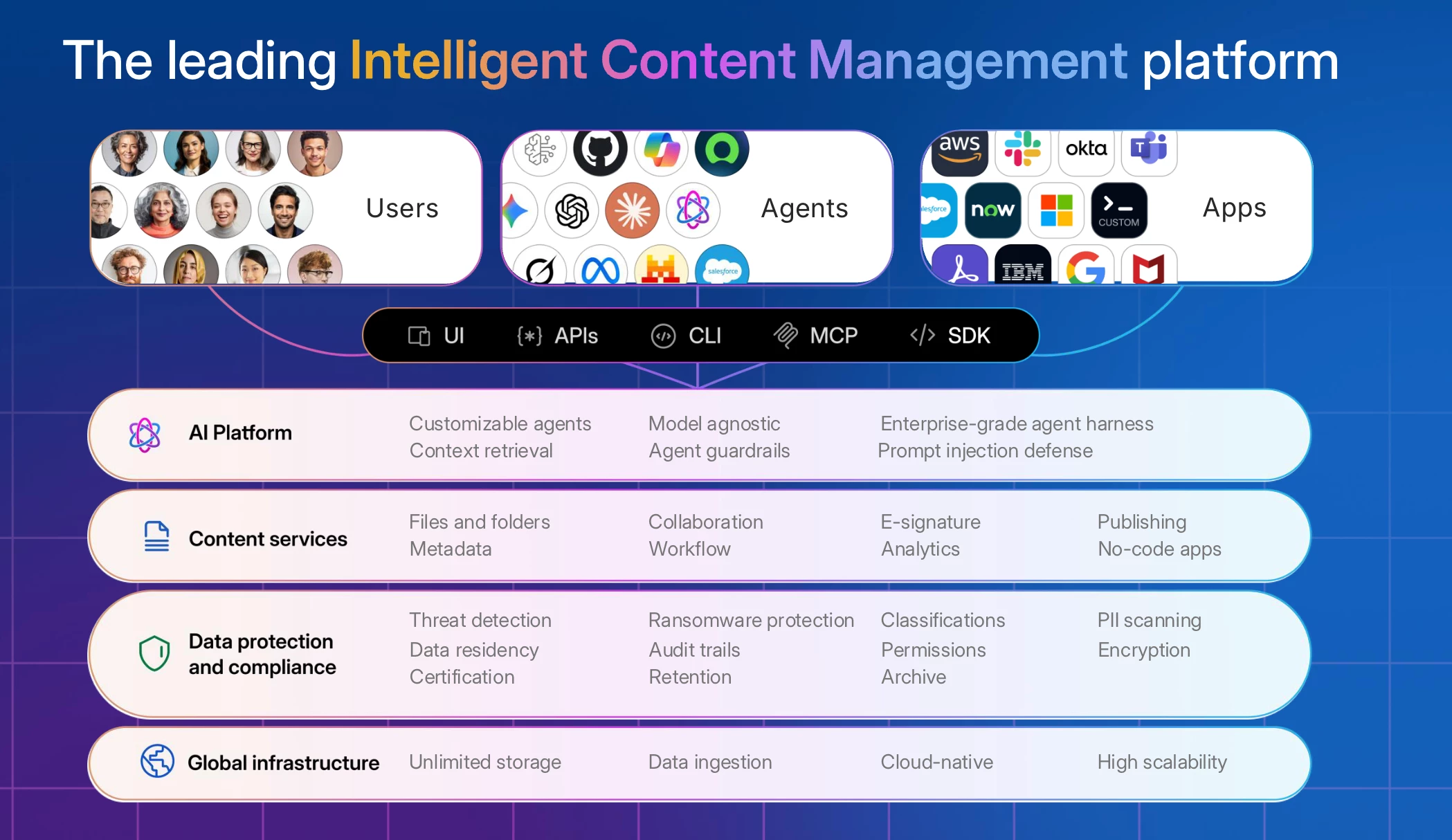
- The central theme of his presentation was the transformation of business through AI and agents, positioning content as the 'lifeblood' for business context across all enterprise functions, from finance and marketing to sales and product development.
- Diego stressed that the foundation of this vision is trust, with the paramount security and governance of content being the top priority.
- Diego then detailed the Box platform's multi-layered architecture: a global infrastructure with unlimited storage, a robust content protection layer, a suite of services for collaboration and advanced workflows, and the powerful Platform that enables the customization and integration of both native and third-party AI agents.
Upcoming Innovations:
Diego highlighted several key areas of innovation currently in development. These include:
- advanced AI-powered governance to ensure agents operate securely
- enhancements to AI security to address new risks
- the expansion of Box Automate to incorporate agents into complex workflows
- the evolution of Box Agents themselves, and a richer environment for developers to interact with the platform's growing capabilities.
Breakout Sessions
Following the introduction, the event transitioned into five breakout rooms, recordings here. These sessions provided a forum for deep-dive discussions and direct Q&A with the respective product leaders.
Agentic Workflows
Introduction
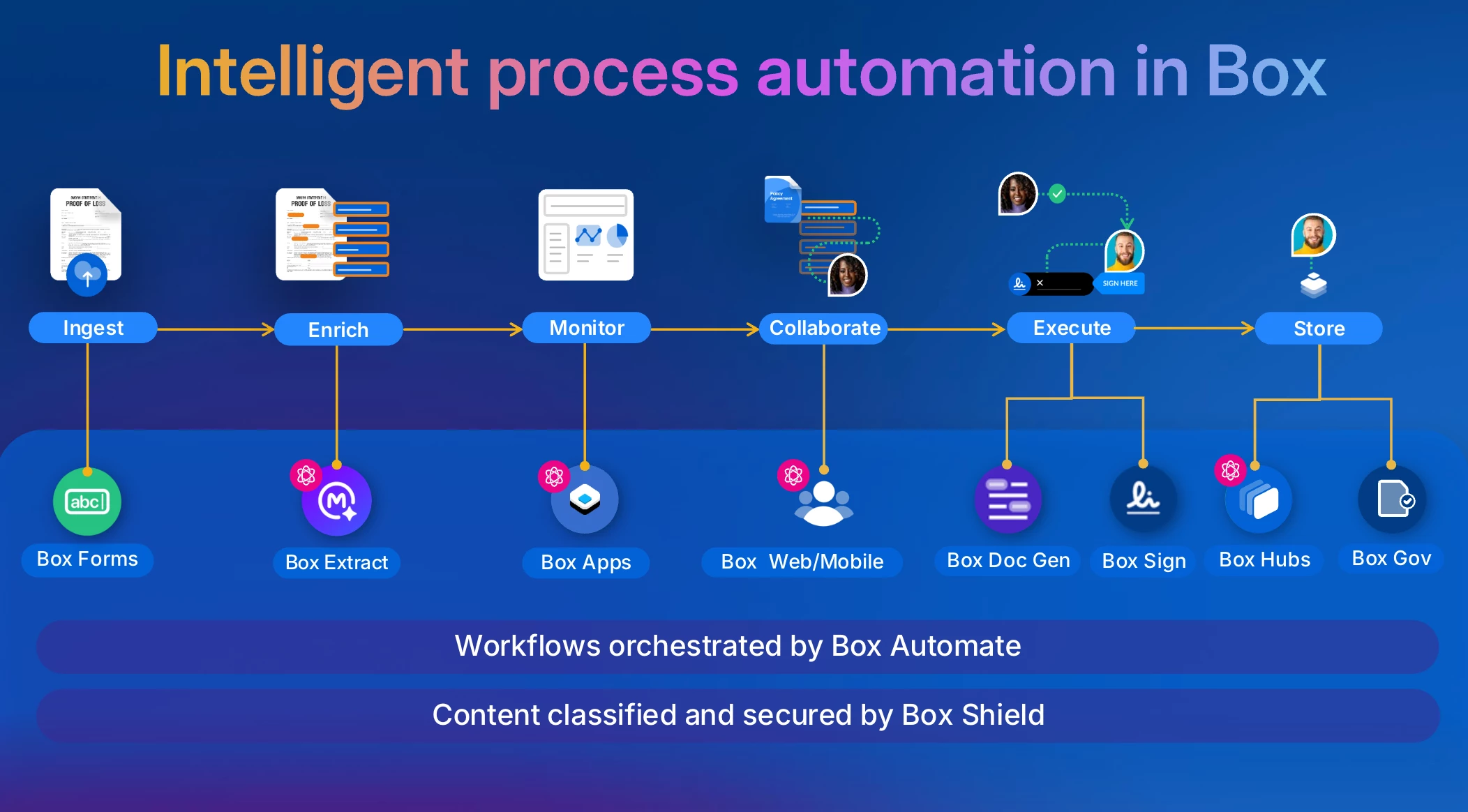
Kelash Kumar (KK), VP of Product Management for Intelligent Workflow Automation at Box, introduces the concept of agentic workflows and intelligent process automation. He outlines the breakout’s focus on Box's latest products designed to handle content-centric processes: Box Extract, Box Automate, and Box Apps.
Main Topics
The Content Workflow Lifecycle
KK breaks down a typical content process into several stages: content ingestion, enrichment (extracting necessary information), process management, collaboration, new document generation (e.g., contracts), and storage. He emphasizes the need for a central orchestration engine to connect these stages seamlessly, which is the problem Box Automate is designed to solve. The core vision is to integrate AI agents, secure content management, and human operators into a single, cohesive system.
Box Extract: Unlocking Information from Content
Box Extract is presented as the tool for enriching content. It uses AI agents to extract specific, structured information (metadata) from unstructured documents like leases, W2s, or invoices. Key features include:
- Customizable Instructions: Users can define what information the AI agents should look for.
- Confidence Scores: The system provides a high, medium, or low confidence assessment for each piece of extracted data, allowing for targeted human review.
- High Accuracy and Scale: Built on a robust foundation using OCR, advanced agentic techniques for cross-examination, and post-processing, Box Extract achieves high accuracy and is already processing over 10 million pages per week.
Box Automate: The Orchestration Engine
Once content is structured with metadata from Extract, Box Automate orchestrates the end-to-end workflow. Described as a significant evolution of Box Relay, it offers more advanced capabilities:
- Complex Processes: Supports loops and conditional branches for sophisticated logic.
- Agent Orchestration: Integrates seamlessly with Box Extract, the general Box Agent, or custom-built agents as steps within a workflow.
- Enterprise-Grade: Features include API-driven triggers, enterprise ownership of workflows, and high scalability.
- Use Cases: Popular applications include employee onboarding, content automation, and contract management, where it has reduced process times by orders of magnitude.
Box Apps: The Process Control Board
Box Apps serves as the customizable dashboard for managing and visualizing automated processes. It allows users to monitor statuses, take action, and gain insights. Recent enhancements include advanced visualizations (bar and donut charts), multi-page applications, and integration with Box AI for natural language search across both metadata and document content.
Box Solutions: Accelerating Deployment
Box Solutions are pre-packaged, configurable templates that combine Box Extract agents, Automate workflows, and Apps dashboards. They are built on best practices and customer feedback to help organizations solve specific use cases (e.g., contract management) quickly and efficiently.
Recent Releases & What's Next (Q2 Roadmap)
KK provided an overview of recent and upcoming features:
- Recently Released: Box Extract and Box Automate became Generally Available (GA). Extract gained confidence scores and expanded file support. Apps received natural language search, new charts, and bulk metadata editing.
- Coming in Q2 for Extract: Ability to create metadata templates directly within Extract, metadata cascade for folder hierarchies, and a 'human-in-the-loop' review interface with bounding boxes in Box Preview.
- Coming in Q2 for Automate: Integration into admin workflows, starting with content archiving.
- Coming in Q2 for Apps: Introduction of 'Custom Actions' to trigger events like legal holds or other workflows directly from an app, and support for multiple metadata templates in a single view.
Q&A Session
The session concluded with answers to audience questions:
- External Events: Box Automate can trigger external events and systems (like Salesforce or AWS Lambda) via an HTTPS outcome.
- Mobile Accessibility: Box Apps are viewable on mobile but not yet fully optimized, a point of feedback taken back to the product team.
- Confidence Thresholds: The feature is being rolled out carefully due to the high computational cost. KK explained Box's 'ensemble approach' where the AI asks for the same data in multiple ways to build a reliable confidence score.
Box AI
Main Topics
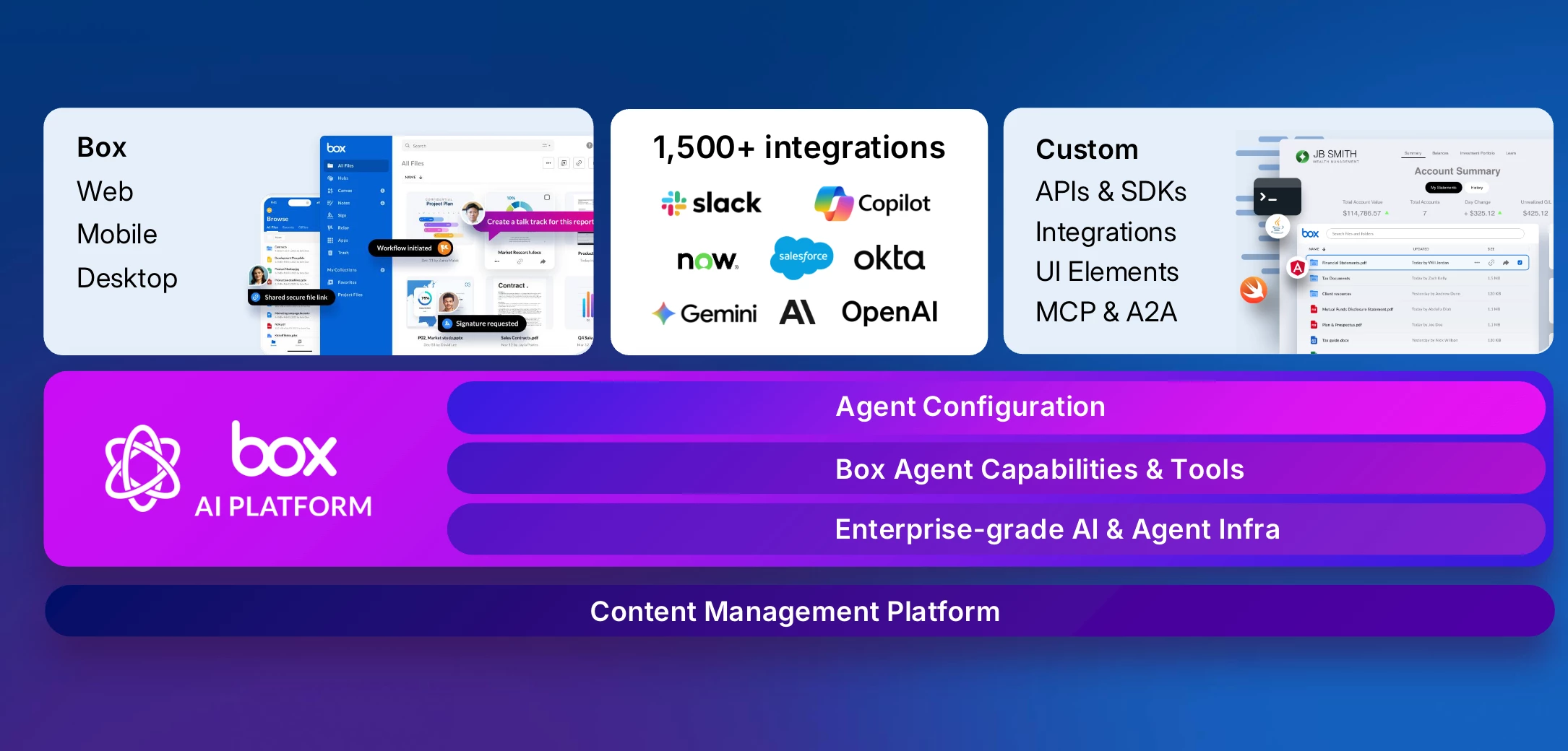
The Box AI platform is presented as a three-tiered structure:
1. Enterprise-Grade AI & Agent Infrastructure
This foundational layer sits directly on top of customer content. Key areas of investment include:
- Observability and Governance: Providing more statistics, insights, and evaluation tools for admins to manage what AI agents are doing, ensuring they work as intended.
- Cost Management: Introducing thoughtful controls and guardrails to manage AI-related costs, allowing organizations to allocate resources effectively for high-value work.
- Model Choice: Maintaining a model-neutral stance, Box is working to integrate the latest models like Claude and importantly, enabling customers to 'bring your own model' (BYOM) for specialized use cases.
- Scaling Access: Expanding Box.ai to more users by increasing access across different service tiers.
2. Agent Capabilities
This section details the 'engine' of the platform, focusing on what the Box agent can do:
- Diverse Content Handling: Expanding the agent's ability to work with and extract insights from a wide variety of content and data sources.
- Web Search Integration: Enabling the Box agent to use the web as a tool, allowing it to combine real-time web data with analysis of private enterprise content in a secure manner.
- Advanced Task Execution: A significant upcoming feature is the agent's ability to run code within a safe, sandboxed environment. This will dramatically increase its capabilities for handling complex actions and creating sophisticated content.
- Security Posture: Reinforcing that all new capabilities are built upon Box's established foundation of enterprise-grade security and governance.
3. Customization and Configuration
Once the foundation and capabilities are in place, the focus shifts to tailoring the AI to specific needs:
- Democratizing Agent Creation: A major initiative is to expand the agent creation experience from AI Studio, currently admin-only, to all end-users. This aims to empower power users who have deep workflow knowledge to build specific, high-adoption agents.
- Introduction of 'Skills': Box is developing the concept of 'Skills,' which are standard operating procedures that can be created and applied to agents or content folders to ensure consistent and controlled outputs.
Roadmap Overview
The breakout provides a timeline for upcoming features:
- Q2 Initiatives: Focus on making the Box agent accessible via APIs for third-party ecosystem integration, launching web search capabilities, and moving content analysis tools (like document and PowerPoint creation) from beta to General Availability (GA).
- H2 Initiatives: Plans include 'AI and Zone' for deliberate data processing location control, enabling agents to take more actions within Box via natural language (e.g., saving files, creating workflows), and building robust agent evaluation tools within AI Studio.
Q&A Session
Key questions from the audience were addressed:
- AI Usage & Cost: Box currently uses a subscription model with usage limits, but also offers a pay-as-you-go option for custom agents. They are developing more granular controls for managing this spending.
- Licensing Tiers: While most core improvements will benefit all tiers, the ability to create custom agents via AI Studio will remain a key differentiator for the Enterprise Advanced tier.
- Central AI Hub: The immediate focus is on leveraging content within Box, but the company is exploring becoming a central hub for content from other sources (like Salesforce) towards the end of the year based on customer demand.
- Governance & Retention: Box is actively working on integrating AI session history with Content Manager to ensure that all AI-generated interactions and content adhere to existing corporate retention standards.
Conclusion
Matt concludes by emphasizing the importance of interoperability in the evolving AI landscape. Box's primary goals are to be the best and most secure place to transform enterprise content and to ensure that the value derived from this content is accessible to any agent or tool a customer chooses to use.
Box Core Platform (including Box Zones)
Main Topics
The presentation focuses on several key areas of development for the Box Core Platform:
- Box Zones Expansion: The most significant update is the expansion of Box Zones from six to twelve regions by the end of the year. This initiative is driven by the need for improved performance and data compliance, allowing content to be stored closer to end-users. The presenter provides technical context, explaining that this requires breaking down Box's original monolithic architecture into deployable microservices. A major future enhancement will be the ability to store and process file metadata within specific regions, which is a critical requirement for many customers and a key enabler for regional AI features.
- BoxShuttle Bulk Mapping: To simplify large-scale content migrations, BoxShuttle will feature a bulk mapping capability. This allows administrators to use a spreadsheet to map source files, folders, and users to their destinations in Box, eliminating the tedious manual process in the UI.
- Search 3.0: The speaker announces that Search 3.0 has been fully rolled out. This new version offers a faster and more intelligent search experience, capable of querying across various file metadata attributes. This enhancement reflects the modern user behavior of searching for content rather than navigating through folder hierarchies.
- Future Metadata Enhancements: A significant portion of future platform work is focused on metadata. The roadmap includes features for metadata auditing and bulk creation. These improvements are crucial for making content smarter and are the foundational layer for powering advanced Box AI capabilities, such as intelligent document generation and sophisticated content analysis.
Q&A Session
The interactive Q&A session addressed several key customer concerns:
- User Deprovisioning and Content Transfer: A university administrator asked about the slow and cumbersome process of transferring a user's content upon deactivation, especially for accounts with millions of files. The presenter explained a new feature for Large Folder Operations (LFOs) that solves this. When a user is deleted, their content will now be made immediately visible and accessible in its new destination, while the actual data transfer and permission changes occur in the background. This eliminates content downtime. This feature is now live for user deletions, with similar functionality for moves and copies planned for later in the year.
- Large File Uploads: The same administrator inquired about challenges with uploading very large files (e.g., 50-70 GB). The presenter discussed two key improvements. First, Box is implementing a dynamic rate-limiting system that will allow for a higher number of files per second to be uploaded during off-peak hours. Second, Box has enhanced its system with 'chunk file uploads,' a form of data deduplication. When a large file is uploaded or revised, Box checks if it already has identical data chunks in storage. If so, it reuses those chunks instead of re-uploading them, significantly reducing transfer times and bandwidth usage.
- AI on Box Drive and Mobile: In response to a pre-submitted question, the presenter confirmed that Box is actively working to bring Box AI features to the Box Drive desktop client and mobile apps. The goal is to bridge the feature gap between the web application and other endpoints, potentially through integrated pop-up windows or seamless links that redirect users to the web app for AI-powered actions.
Box Developer Platform (including APIs)
Introduction
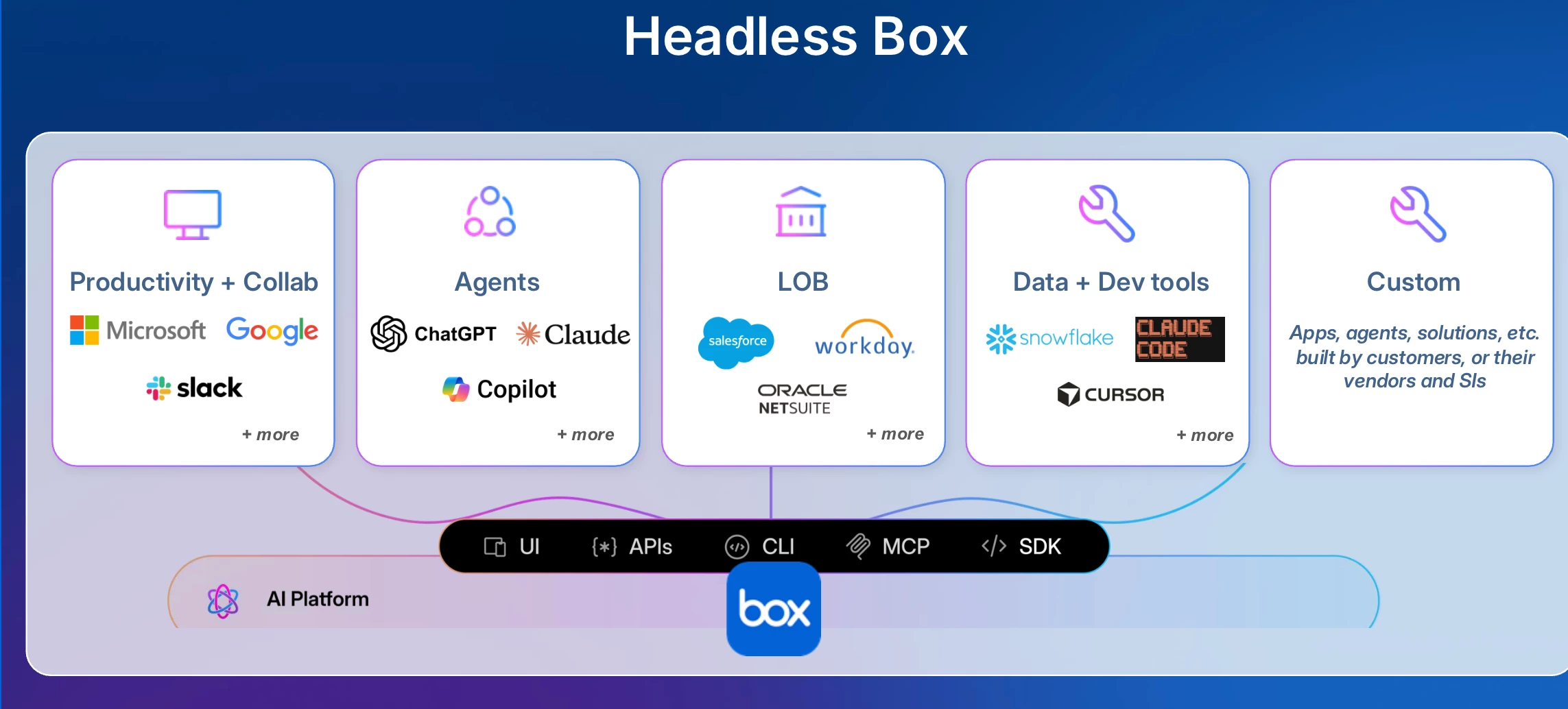
The breakout begins by introducing the core focus of the Box Developer Platform: providing a comprehensive set of interfaces for interacting with Box. Beyond the familiar web UI, the platform offers numerous headless access points, including APIs, a recently upgraded CLI, the MCP server, and various SDKs. These tools enable powerful integrations and custom applications.
Main Topics
Headless Access and Emerging Interfaces
The presenter details standard methods for headless interaction with Box, such as integrations with collaboration tools (e.g., Microsoft PowerPoint) and line-of-business applications like Salesforce and SAP. A key focus is on the new interfaces emerging with the rise of AI:
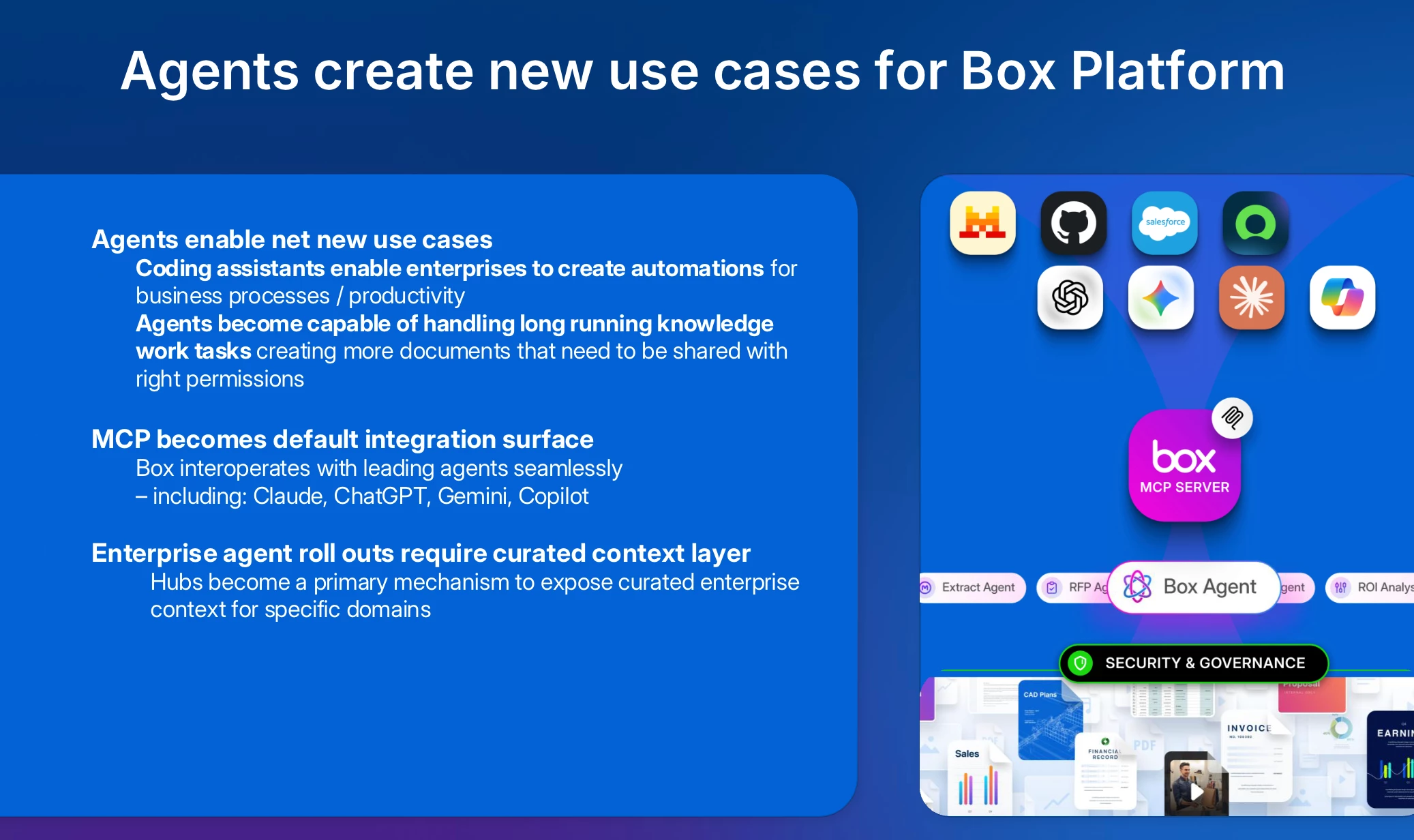
- AI Agent Interfaces: A common pattern is connecting AI agents like ChatGPT or Claude to a company's Box instance via the MCP server, allowing users to query their enterprise content through a conversational interface.
- Coding Agents: Developers are increasingly using coding agents to build custom applications leveraging Box APIs. Another novel use case involves coding agents running locally on a developer's machine, using Box Drive as a local folder to read and write files for context.
-
Deep Dive into AI Use Cases and Developer Tools
The session explores how AI is driving new traction for Box APIs. The developer experience has been simplified, making it easier for more developers within an enterprise to build and experiment. The concept of long-running, independent AI agents performing knowledge work (e.g., due diligence) using Box as a central content layer is also introduced. The Box MCP server is highlighted as a critical component, enabling secure connections to major AI models like Claude, Copilot, and Gemini. For enterprises building their own internal agents, Box Hubs is being used to create curated knowledge bases.
Platform Roadmap
The presenter outlines the key focus areas for the platform's future:
- Simplified Developer Experience: Initiatives include simplifying authentication, providing AI unit entitlements even for free developer accounts, and releasing an `npm install box` command to easily download the CLI and SDKs.
- Enhanced Security and AI Agent Access: Plans include adding security guardrails to the MCP server and making the Box AI agent available via Slack and MCP.
- Improved Admin Experience: Upcoming features will allow admins to easily search and sort their custom applications and view API call consumption against their plan entitlements.
Use Case Discussion & Q&A
The latter half of the breakout features an interactive discussion with attendees about their specific use cases:
- ServiceNow Integration (Chandler): Chandler discusses integrating Box with ServiceNow, often building custom API solutions because the official integration ('spoke') is too limiting. He provides valuable feedback on the Box Sandbox, requesting features like the ability to disable notifications and better mirror production user structures without being a live production environment.
- University Content Management (Garrett): Garrett, from a university, explains their use of Box APIs to manage content and users at scale. Their primary project involves centralizing data into service account-owned folders to prevent data loss when employees leave. They also have an automated de-provisioning process. He echoes the need for a more robust sandbox environment.
- HRIS & Box Sign (Carrie): Carrie shares how her small team uses Claude connected to Box via MCP for all employees. Her main project involves building a custom Human Resources Information System (HRIS) from scratch and integrating Box Sign to automate sending HR documents like I-9s and W-4s to new hires.
Security and Governance
Introduction
Manoj Asnani, head of product management for security, compliance, and governance at Box, outlines the session's focus on Box's foundational capabilities in advanced data protection and compliance, designed to help customers securely manage their most sensitive content throughout its lifecycle. The presentation will cover recent product releases and provide a detailed look into the roadmap for the rest of the year, with a significant emphasis on AI security.
Main Topics
1. Recap of Recent Releases (Last 6 Months)
Manoj provides a summary of significant features launched recently:
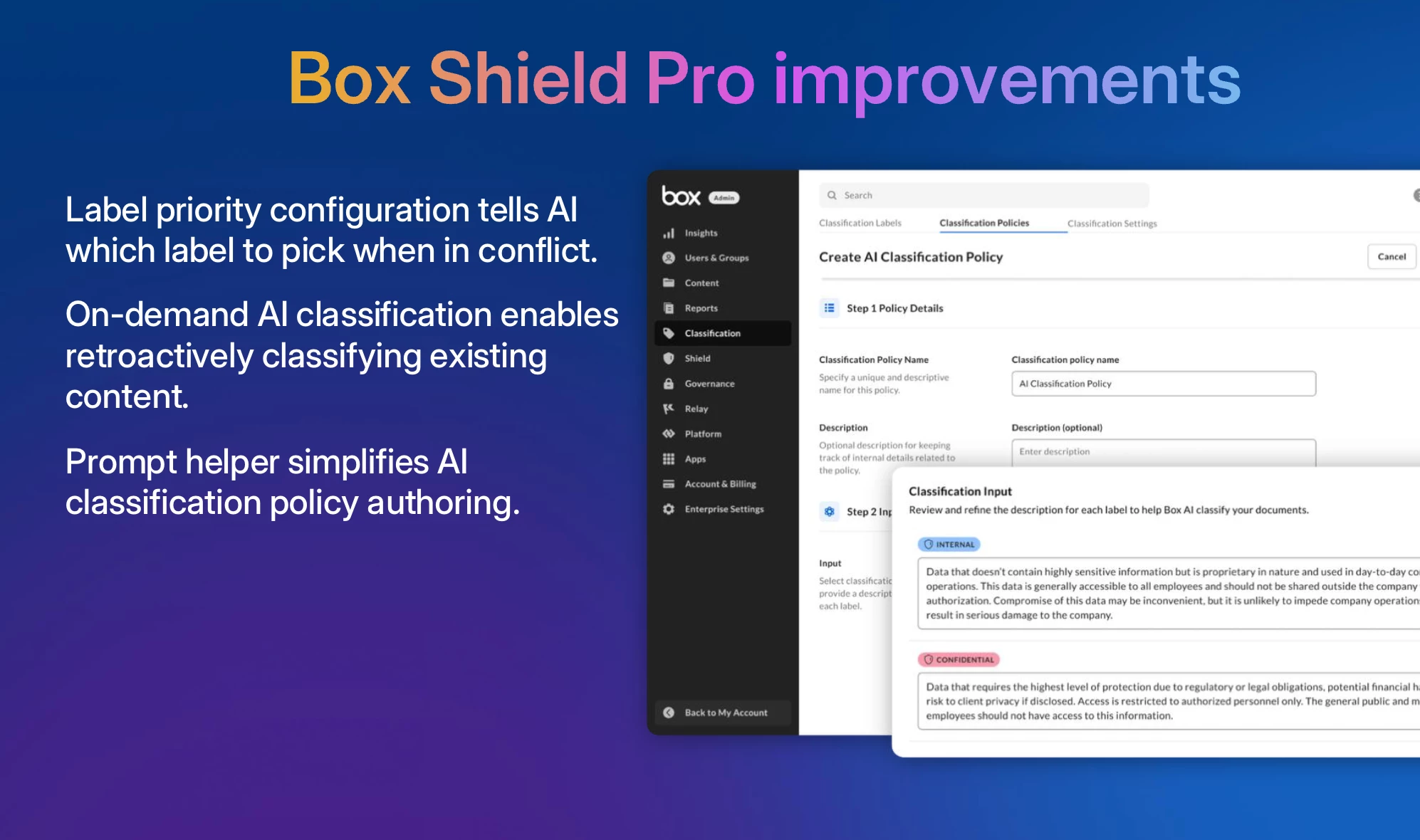
- BoxShield Pro: An advanced, AI-driven version of BoxShield that allows for nuanced content classification using simple, natural language prompts (e.g., 'classify documents that read like a pre-release M&A announcement'), going beyond traditional keywords and regex.
- Collaboration Controls: Introduction of auto-expiry for shared links to enhance security for external collaboration.
- Watermarking Enhancements: Launch of video watermarking and the ability to customize static watermarks with dynamic data like usernames.
- Account Takeover Prevention: Improvements to Multi-Factor Authentication (MFA), including phishing-resistant MFA and MFA for external collaborators on mobile devices.
- Governance and Compliance: Enhancements to disposition visibility, a completely revamped Content Manager user experience, and achieving FedRAMP High compliance.
2. Upcoming Features: A Focus on AI Security and Governance
The core of the presentation details Box's forward-looking strategy for securing content in the age of AI.
- BoxShield Pro Enhancements: The platform will soon allow classification of all historical, inactive content, ensuring that legacy data is protected against modern threats. This addresses the significant risk posed by unclassified, dormant sensitive data.
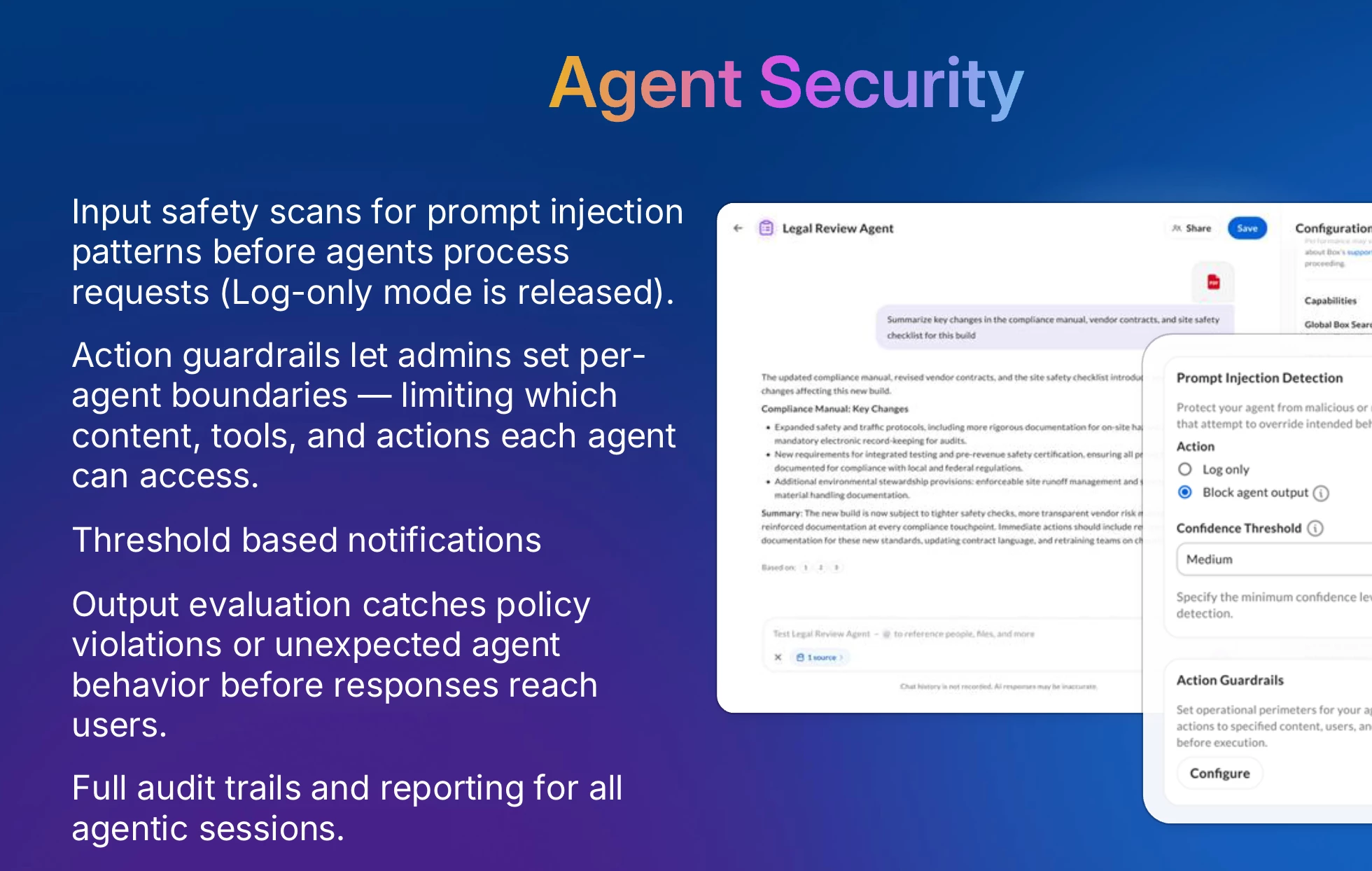
- AI Agent Security (Defense-in-Depth Approach): Box is building a multi-layered security framework for AI agents (both internal Box agents and external ones like Co-pilot):
- Prompt Safety: Scanning all incoming prompts for prompt injection attacks to ensure agents act on safe inputs. - - Agent Guardrails: Empowering admins to set specific policies on what agents can and cannot do (e.g., 'prevent external agents from accessing sensitive files' or 'block agents from moving content to externally shared folders'). - Activity Monitoring & Anomaly Detection: Providing full visibility into all agent activities and allowing admins to set thresholds to detect and block anomalous behavior, such as an agent performing a bulk download of files. - Output Scanning: Implementing policies to scan, redact, or block the output generated by AI agents to prevent the leakage of sensitive information. - Audit Trails: Creating comprehensive audit logs for every action taken by any AI agent on any piece of content.
3. Advanced Governance and Roadmap Highlights
- Agent Governance: Extending governance controls like retention policies and legal holds to the AI sessions themselves, treating them with the same importance as content.
- Policy-Driven Archive: A new capability allowing organizations to create automated policies to archive content based on metadata or inactivity, moving it out of active circulation for long-term compliance.
- Records Management: An upcoming out-of-the-box feature to allow enterprises to formally declare content as official records for legal and compliance purposes.
Q&A Session
Manoj addresses two key questions from the audience:
- Multiple Classification Labels: When asked if a file can have multiple classification labels, Manoj explains that while historically challenging due to priority conflicts, the development of new label priority configuration features makes this more feasible. It is currently under consideration.
- Data Residency: In response to a question about data residency, Manoj confirms Box is continuously expanding its capabilities by adding new zones (Israel, Switzerland, Canada) and, crucially, moving towards in-region processing of metadata, not just storage of files.
Conclusion
The breakout concludes by reinforcing Box's deep investment in building a secure and governable framework for the era of AI. The upcoming features are designed to empower organizations to embrace the productivity gains of AI while maintaining robust control and visibility over their most valuable content.
Overall Recap and Q&A Highlights
After the breakouts, the group reconvened for a final recap.
- Attendees expressed significant interest in new features like agent governance and the advanced automation possibilities with Box Automate.
- Product leaders shared key themes from their breakouts, including a strong demand for mobile-responsive views in Box apps and a recurring use case for combining Doc Gen and Box Sign for HR processes like generating offer letters, often involving integration with systems like Workday.
- Diego noted the high level of interest in how Box will integrate with agents from major AI labs (e.g., OpenAI, Anthropic) and suggested a future deep-dive session on the topic.
Please comment in the replies if there are specific features you are most interested in!